Friday, July 26, 2019

A Bad Day Trip

I'll admit it's been almost a month now since I last updated my noble readers on my Scandinavian adventures! The reason is embarrassingly simple: I went on a bad day trip on Saturday, July 6th, and didn't want to blog about it!
Carl Larsson's home, Sundborn in Dalarna, Sweden

The Thursday before this minor catastrophe was half term for my Swedish program, and Swedish feasting turned out to be a very interesting insight into their culture. There are many rules for how dining in Sweden must be conducted; at many formal occasions, there are even alotted bathroom breaks. Each course was punctuated by musical performances and speeches, and the many digestives offered throughout the meal were always accompanied by a drinking song! We ate a beet salad, moose meatballs, and a chocolate lingonberry moose, sitting at table for more than three hours. Afterwards, there was dancing.

Our program director has a passion for singing.

Now about the day trip. I wanted to visit the home of Carl Larsson, probably the most famous Swedish painter. He lived at the end of the 19th century, at an idyllic Dalarna farmhouse called Sundborn. Eagerly, I purchased train tickets (nearly three hours each way) and went on an adventure.

But when I arrived in Falun, the nearest city to Sundborn, there were NO busses. Only one bus travels out to Carl Larsson's home each day. There is no tourism infrastructure in place in the sleepy little province of Dalarna. After trekking around Falun for forty five minutes, I finally reach the tourist office. She sends me off in a $40 taxi.

The tour of Carl Larsson's home (no student discount) was conveniently just about to start. The only other americans are a family of five with a screaming infant. The child wails and scrapes her hands along the artifacts for the full tour, while the jovial, blond haired tour guide pretends it isn't happening. Utter nightmare. In addition, maybe it's just my bad mood at this point, but Carl Larsson's perfect country estate has an eerie, Stepford quality to it. It's all just a little too perfect, all thanks to his artistic yet clearly oppressed wife Karin.

As soon as the tour is over, I am forced to rush back to catch the single bus of the day! so of the ten hours or so that I was traveling, I only got to be at Sundborn for about 90 minutes. I have to wait two hours at the train station to get back to Uppsala.

So there is my tale of woe. The moral? Things don't always go well when traveling. Attitudes cannot always be good, and travel cannot always be smooth. But we keep going nonetheless. Never give up, never surrender!

Sunday, June 30, 2019

The Boat to Skokloster Castle


Because I apparently don't know how to take a day off (except today; I finally put my foot down today), yesterday I wrangled up a crew to accompany me on a boat cruise to Skokloster Castle, about an hour and forty minutes down river from Uppsala. Beer in hand, I admired the passing countryside, the lake houses and the lily pads, which spun and dipped beneath the water in the wake of the boat's engine. There was bright sun, so of course I got a little sunburned.


The M/S Kungen Carl Gustav is a boat with historic origins. Though now a modern vessel with modern engines, it has been afloat since the 19th c, with a smokestack for proof.


After a peaceful journey down the river and then across Lake Mälaren, the boat made dock in the historic, 17th c harbor of Skokloster, once the home of the Wrangel family. Built between 1654 and 1676 for Count Carl Gustaf Wrangel, a hero of the Thirty Years War, the castle is the largest ever owned by a private family in Sweden, and is considered one of the most important baroque castles in Europe. It is a rectilinear design around a central courtyard, with a hexagonal tower at each of the four corners. Originally, it was constructed to be approached by water, so the front faces the lake! This made a boat trip ideal.
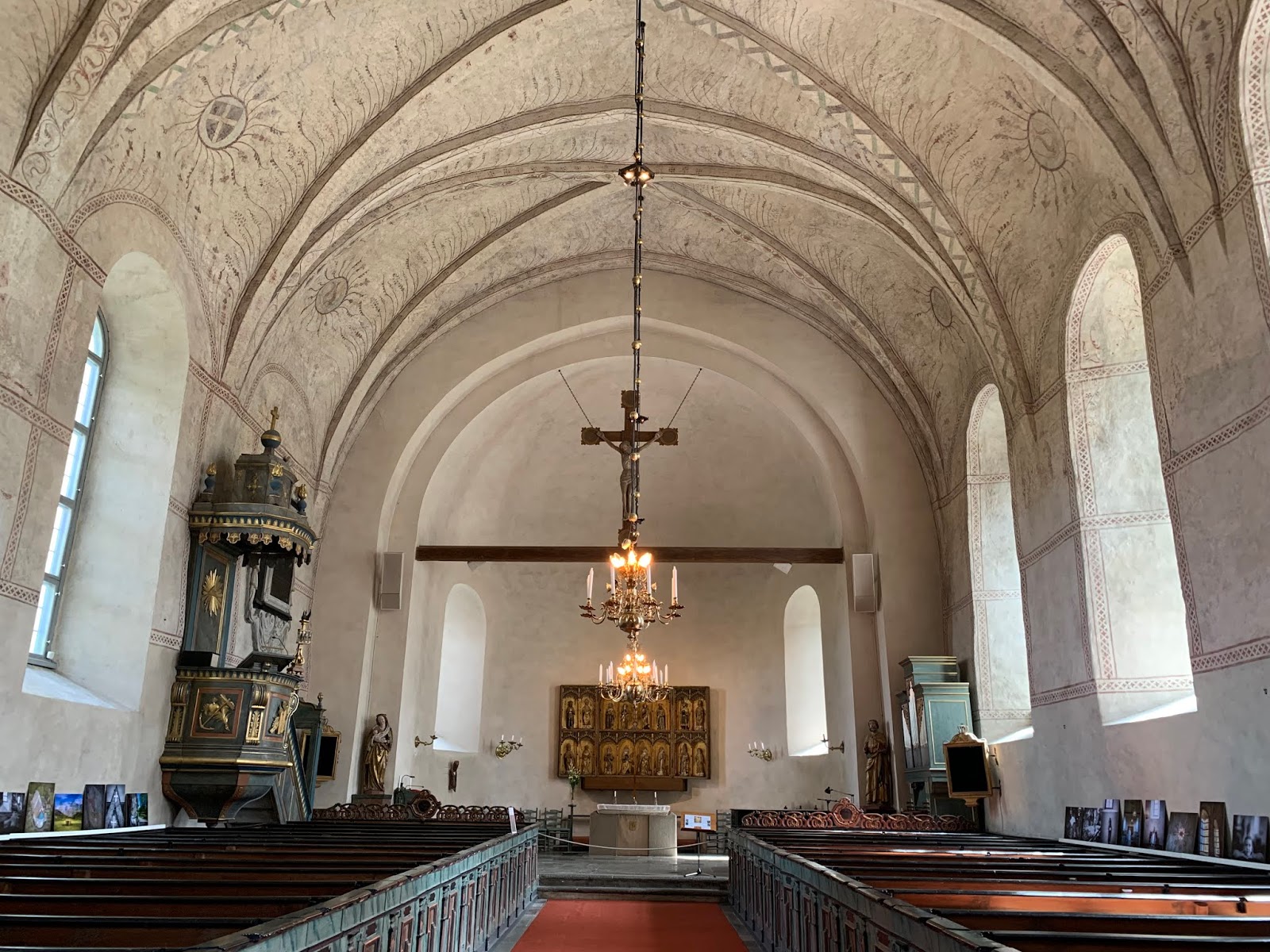


At the family's church, originally a 13th c convent, we were greeted and immediately given a tour by a friendly docent, who told us some of the history of the family, explained the presence of their heraldry (adorned with four helms rather than three, even though only king's usually had this honor), and even showed us how to peep into the crypt to see the 24 coffins stowed there, all contained members of the Wrangel family.


Inside, we toured the bedrooms on the first floor and the small museum on the ground floor. I was particularly impressed (and sort of disgusted) by the 17th c gilded and hand painted leather wallpaper on the walls.

A 17th c dried puffer fish, expanded with hay and imported from distant lands 

17th c leather wallpaper 


There was also a very famous painting there, which I hadn't expected to see! Guiseppe Arcimboldo's Vertumnus, The God of Seasons, 1590-1591, a portrait made of fruits which bears the features of the Emperor Rudolf II.


And then a peaceful voyage back to Uppsala!


Sala Silvermine


After our moose encounters, the crew headed down the road to the Sala Silvermine, what Gustavus Adolphus called "Sweden's purse" during the Thirty Years War (1618-1648). The mine has medieval origins (eee!) and was first mined extensively during the fifteenth century. The mining techniques created severe instability in the 16th c, which led to a terrible cave in in the 17th century. There are still bones buried under this wreckage.


Back in the oldest days of the mine, they didn't have dynamite to clear rock with. They would build fires that would burn for two days to fracture the rock, and then chisel it away. They could get two centimeters in each time they did this, yet in the four hundred years the mine was active, they managed to go 380 m into the earth. Today, only 155 m remains above water, as the mine was shut in 1969. We went down 60 m through the Kristinashaft (named for the Swedish queen who ruled as it was made).

It was very very cold under the earth (and as you remember, I hadn't dressed warmly enough for the day to begin with!) Everyone was worried about my bare arms, which led to many friendly and comforting hugs, but I was honestly fine. Mind over matter, man! The scariest bit was descending the wet metal spiral staircases that hovered above shivering drops straight down into hell itself (apparently). There were a few hearty ghost stories, too. When entering the mine, you must knock three times to announce your presence to the lady of the mine. If you see a woman wearing a white dress, you're good to go. But if she appears to you in a black dress, and you hear the sound of falling rock, it might be a good idea to clear the area as soon as possible.


The magnificent subterranean vistas were basically impossible to photograph, but it was stunning to imagine the underground cathedrals the brave Swedish miners managed to chisel out of bare rock hundreds of years ago. Staring down the stunning depth of the Kristinashaft was enough to weaken anyone's knees, and those miners used to swing across its insane breadth in buckets.


Our guide, dressed in historic foreman's clothing, granted us the luck of the mine with a song. In the past, this chamber was used as a concert hall!

Moose Park!

On Friday, UISS took an excursion to a moose park and silver mine! I hadn't signed up in time (I tried Wednesday, and apparently Tuesday at noon was the cut-off), so there was a good chance I wouldn't get to go! Luckily, there was a pub crawl the night before, so I got up and stood outside the bus to see if anyone would be too hungover to go. They were. So off we went!

The moose park was about an hour from Uppsala on a large tract of land. It was a chillier day than I had expected, so I waited in the sun until the moose man had loaded up his tractors and was ready to take us on a tour of his passion project.


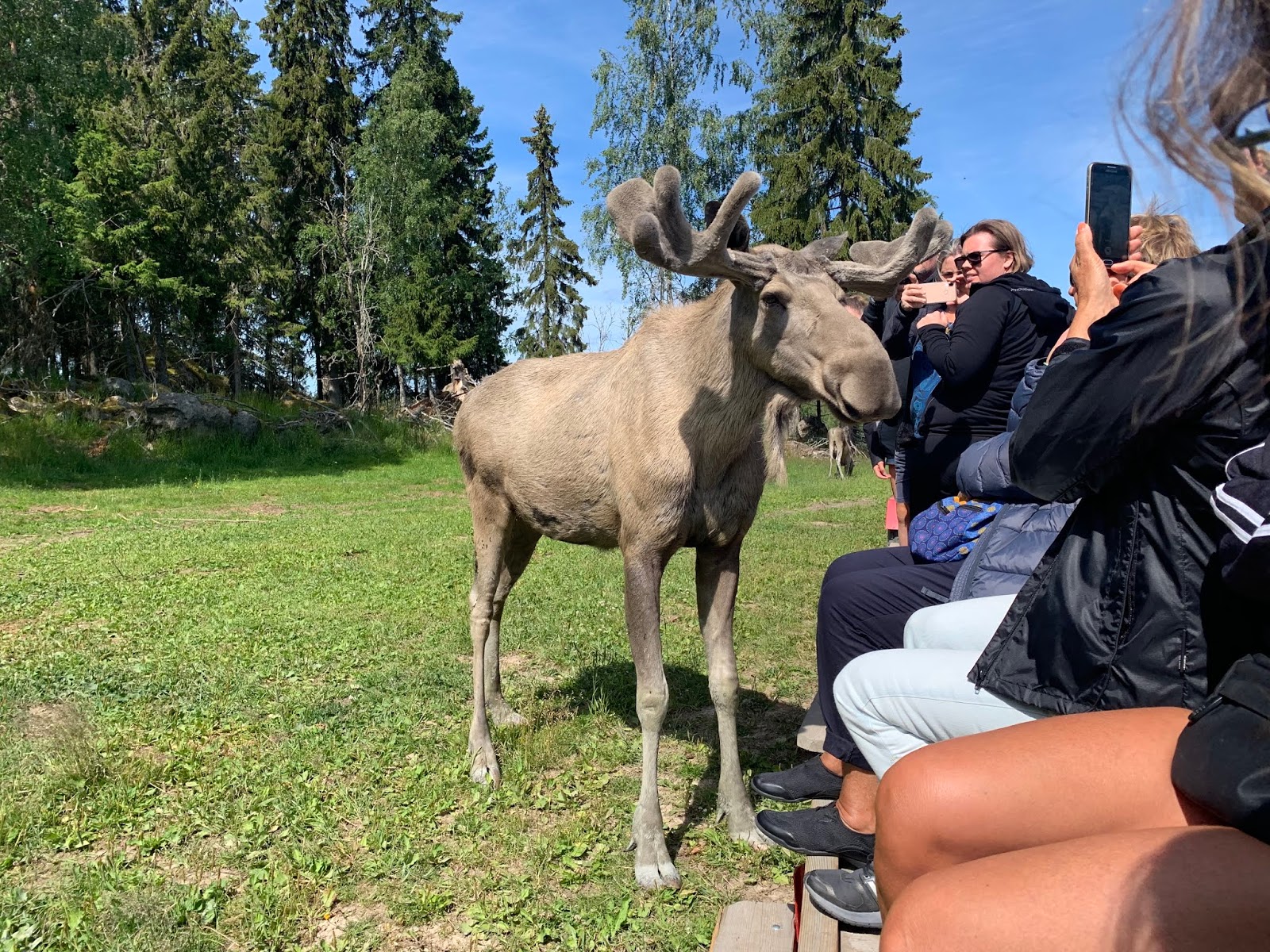
I got to pet a moose; specifically, I got to touch his fuzzy antlers (which they can feel!). Moose hair in summer is covered with a natural mosquito repelling grease that I didn't really want to get on my hands ...


Here is what I remember about moose: Only the males have antlers, and they grow them from May to September in order to impress the lady moose when the time is right in September. The antlers then lose their blood supply and drop off. Baby moose arrive eight months later, and the mothers don't want the guys around anymore, so the moose man moves them into their own pin. The moose man has a huge amount of land, so if the moose don't want to be in his tour, they can simply run off into the wilds. We probably saw about fifteen of his seventy total moose. When a new moose is born, the moose man stays with them for three days outside, and then spends huge amounts of time with them after that, so that they will trust him for life. When a little baby girl moose named Olivia was rejected by her mother (because her brother was taking all the milk ...), the moose man took her to live inside his home for three months.


My favorite moose was named Lugwig. He was a blond moose, and kept getting in trouble. He would go and try to stick his face in people's laps, and the moose man, obviously very fond of him, would yell, "Ludwig! Nej, Ludwig!!"

Ludwig the moose
There were babies too!


National Museum in Stockholm

Last Wednesday the art history class took our first field trip to Stockholm to visit the National Museum there. This was my first time in the city, and it was horribly gray and rainy--one of the first days of less than amazing weather I've had here! So I won't say much about Stockholm itself; i'll save that for a fuller visit!

The National Museum is located right in the center of Stockholm, near parliament and the royal palace (still occupied--the Swedes still have a royal family). It was first founded when King Gustav III donated his royal art collection to a new museum in 1792, and its current building opened in 1866 after twenty years of construction. They've recently done a major renovation and an entirely new hang, which made this visit very interesting. Some of the big changes include a change from a chronological hang to a thematic hang, so that each room has a overarching theme relating to the formation of Sweden as a nation. There is an emphasis on Swedish painters, but they are interspersed with other works, particularly 19th c French painters that played a role in the developed of Swedish modernism (Manet, Renoir, all the old boys, etc. A whole lot of good Rembrandts, too)


Anders Zorn, Midsommardans, 1897 

The walls in each room are also very brightly painted. In Philadelphia, the Baroque room was recently repainted a bright, jewel tone blue that draws new details from the ornate and theatrical paintings hung against that color. Here, the rooms are much larger, so the brightly colored walls don't always correspond so carefully to the paintings hung on them. Still, it was refreshing. Some of the history paintings, most famously, the Coronation of Gustav III by Carl Gustaf Pilo (1782-1793) were hung very high on the walls as they would have been in contemporary salons. The new hang also  brings in decorative arts and ceramics, so the paintings are contextualized with furniture and dinnerware (and even sometimes placed in conversation with contemporary art.)

Several important Swedish history paintings: 

Carl Larsson, Midvinterblot, 1915 (some nice Medieval fake news)
Carl Gustaf Pilo, The Coronation of Gustav III, 1782-1793

Gustav Cederström, Bringing Home the body of Charles XII, 1884. 

One thing I particularly noticed and liked in the National Museum was the heavy inclusion of women artists beginning with the 19th century. Sweden has argued that women were more easily welcomed into the art world here than elsewhere, and their curation certainly seems to support that. I've never seen so many paintings by women on museum walls, and particularly paintings of women actually painting. The famous male Swedish artists were juxtaposed with women who painted similar themes. Several women artists who I discovered were Eva Bonnier, Hanna Pauli, Fanny Brate, and Elsa Beskow (am especially obsessed with her nursery rhyme illustrations).

Eva Bonnier, Hushållerskan, 1890

Fanny Brate, A Day of Celebration, 1902

Elsa Beskow, A Nursery Rhyme, 1903

Also there was really great cake :D.


And this cat! I got a tote bag of him.

Bruno Liljefors, Cat in a Flowery Meadow, 1887

Monday, June 24, 2019

School Days

Svenska schola begins promptly each morning at 8:30! (and in Sweden to be late is considered very rude. I find being late quite rude in America, too, but there you go ...). We do Swedish work for four hours with a Fika break at 10. I'm in the A1 class, which means I am a complete beginner.


There's our teacher, Henrik. He is a musician and loves to teach us Swedish songs about trolls and sailing and things. Today we learned the "Imse Vimse Spindel" (Can you guess what song that is?) We found out today that Henrik's brother is a very famous Swedish film director.


At lunchtime, we all go to our daily appointed restaurants around town and use little coupons we've been given to eat! My favorite thing about these lunches is that there is always complementary coffee and a little cookie afterwards. At 1:45, we return to schola for our afternoon courses. This three weeks, I'm in a Swedish art history course. It's nice, because we get to go on field trips once or twice each week. Johann, our instructor, is very nice; his research is about heritage sites, monuments and cultural memory.


After class, it's time to do homework! It's been a long time since I've had so many hours of school each day, so I am pretty worn out by the end of the day at 4 pm. Goodness. Day jobs must be hell. 

Sunday, June 23, 2019

Gamla Uppsala

Great church day today! Accompanied by a crew of lovely new friends, I made my way by bus about four and a half kilometers out to Gamla Uppsala, or old Uppsala, one of the most important pre- and early- Christian sites in medieval Scandinavia. Before the city and the archbishopric moved to its present day location in the 13th century, Gamla Uppsala was a center for both religious and political life in medieval Sweden. Contemporary sources including (but not limited to) Adam of Bremen, tell us that this was a site of the annual thing, or political meeting, as well as a site of cult practice.


The Romanesque church was the original Uppsala cathedral, and inside it is wonderfully light and airy, with the remains of wall paintings and a number of medieval objects. It smelled amazing inside, and of course I loved it more than the new gothic cathedral in town. My favorite object was an 11th c chest made from the limb of a tree kept whole. Don't quote me on this, but Gamla Uppsala was originally a cult site with a very important sacred tree. Interesting that they left this limb as a chest, so you can still see its original form ... hmmm ...


After walking around the church and its timber bell tower (locked, darn it), we climbed the nearby burial mounds, which survive from the 5th and 6th centuries. They were very impressive, and the view from the top was satisfying. The surrounding countryside seemed quite flat from the manmade hills, and I could see all the way to Uppsala.


We then headed over to the picturesque Odinsborg Cafe for Fika! (teatime in Sweden). I had a blueberry tart and a much-appreciated coffee. A wonderful Sunday adventure!