Sunday, June 30, 2019

National Museum in Stockholm

Last Wednesday the art history class took our first field trip to Stockholm to visit the National Museum there. This was my first time in the city, and it was horribly gray and rainy--one of the first days of less than amazing weather I've had here! So I won't say much about Stockholm itself; i'll save that for a fuller visit!

The National Museum is located right in the center of Stockholm, near parliament and the royal palace (still occupied--the Swedes still have a royal family). It was first founded when King Gustav III donated his royal art collection to a new museum in 1792, and its current building opened in 1866 after twenty years of construction. They've recently done a major renovation and an entirely new hang, which made this visit very interesting. Some of the big changes include a change from a chronological hang to a thematic hang, so that each room has a overarching theme relating to the formation of Sweden as a nation. There is an emphasis on Swedish painters, but they are interspersed with other works, particularly 19th c French painters that played a role in the developed of Swedish modernism (Manet, Renoir, all the old boys, etc. A whole lot of good Rembrandts, too)


Anders Zorn, Midsommardans, 1897 

The walls in each room are also very brightly painted. In Philadelphia, the Baroque room was recently repainted a bright, jewel tone blue that draws new details from the ornate and theatrical paintings hung against that color. Here, the rooms are much larger, so the brightly colored walls don't always correspond so carefully to the paintings hung on them. Still, it was refreshing. Some of the history paintings, most famously, the Coronation of Gustav III by Carl Gustaf Pilo (1782-1793) were hung very high on the walls as they would have been in contemporary salons. The new hang also  brings in decorative arts and ceramics, so the paintings are contextualized with furniture and dinnerware (and even sometimes placed in conversation with contemporary art.)

Several important Swedish history paintings: 

Carl Larsson, Midvinterblot, 1915 (some nice Medieval fake news)
Carl Gustaf Pilo, The Coronation of Gustav III, 1782-1793

Gustav Cederström, Bringing Home the body of Charles XII, 1884. 

One thing I particularly noticed and liked in the National Museum was the heavy inclusion of women artists beginning with the 19th century. Sweden has argued that women were more easily welcomed into the art world here than elsewhere, and their curation certainly seems to support that. I've never seen so many paintings by women on museum walls, and particularly paintings of women actually painting. The famous male Swedish artists were juxtaposed with women who painted similar themes. Several women artists who I discovered were Eva Bonnier, Hanna Pauli, Fanny Brate, and Elsa Beskow (am especially obsessed with her nursery rhyme illustrations).

Eva Bonnier, Hushållerskan, 1890

Fanny Brate, A Day of Celebration, 1902

Elsa Beskow, A Nursery Rhyme, 1903

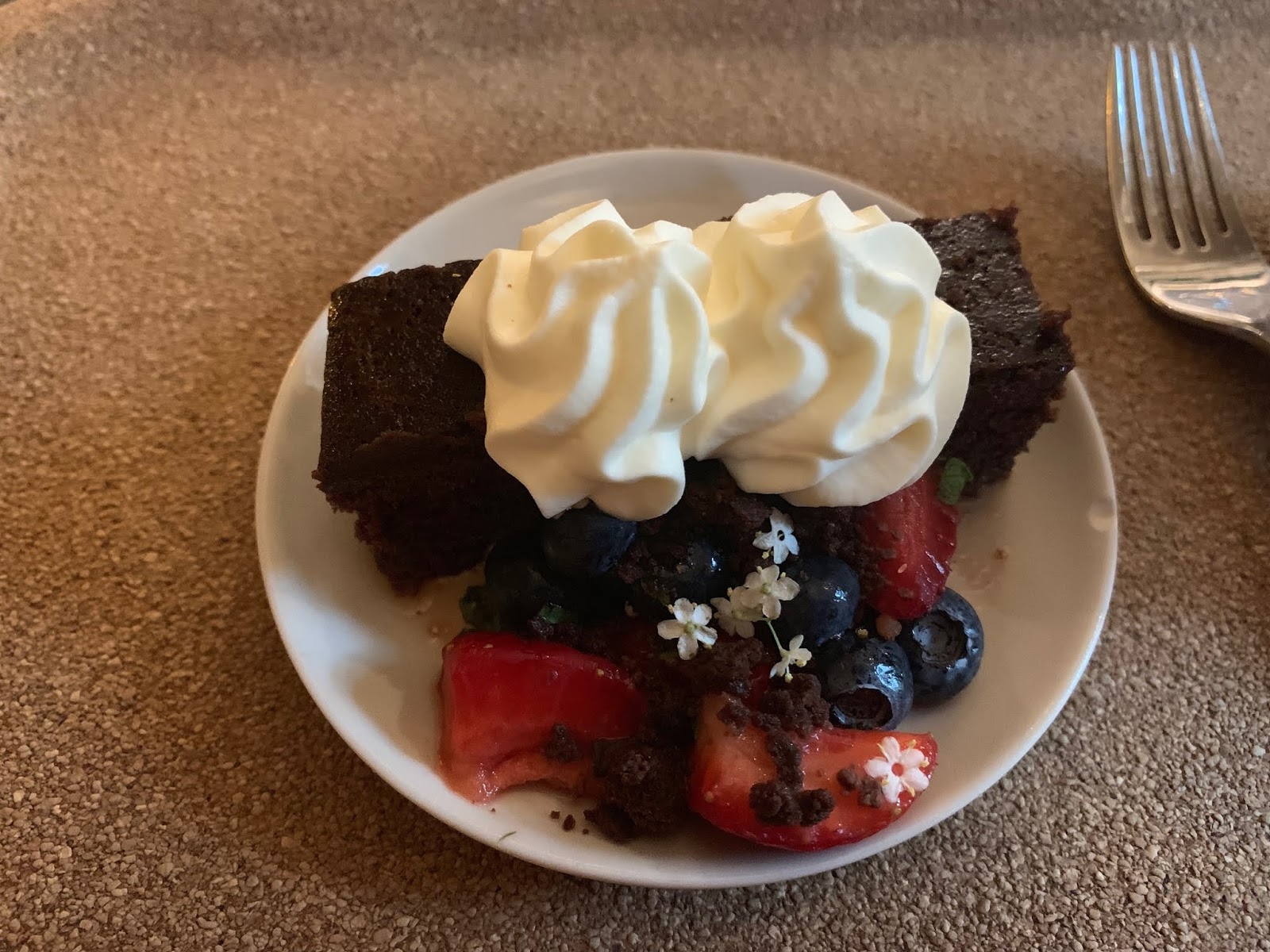
Also there was really great cake :D.


And this cat! I got a tote bag of him.

Bruno Liljefors, Cat in a Flowery Meadow, 1887

Monday, June 24, 2019

School Days

Svenska schola begins promptly each morning at 8:30! (and in Sweden to be late is considered very rude. I find being late quite rude in America, too, but there you go ...). We do Swedish work for four hours with a Fika break at 10. I'm in the A1 class, which means I am a complete beginner.


There's our teacher, Henrik. He is a musician and loves to teach us Swedish songs about trolls and sailing and things. Today we learned the "Imse Vimse Spindel" (Can you guess what song that is?) We found out today that Henrik's brother is a very famous Swedish film director.


At lunchtime, we all go to our daily appointed restaurants around town and use little coupons we've been given to eat! My favorite thing about these lunches is that there is always complementary coffee and a little cookie afterwards. At 1:45, we return to schola for our afternoon courses. This three weeks, I'm in a Swedish art history course. It's nice, because we get to go on field trips once or twice each week. Johann, our instructor, is very nice; his research is about heritage sites, monuments and cultural memory.


After class, it's time to do homework! It's been a long time since I've had so many hours of school each day, so I am pretty worn out by the end of the day at 4 pm. Goodness. Day jobs must be hell. 

Sunday, June 23, 2019

Gamla Uppsala

Great church day today! Accompanied by a crew of lovely new friends, I made my way by bus about four and a half kilometers out to Gamla Uppsala, or old Uppsala, one of the most important pre- and early- Christian sites in medieval Scandinavia. Before the city and the archbishopric moved to its present day location in the 13th century, Gamla Uppsala was a center for both religious and political life in medieval Sweden. Contemporary sources including (but not limited to) Adam of Bremen, tell us that this was a site of the annual thing, or political meeting, as well as a site of cult practice.


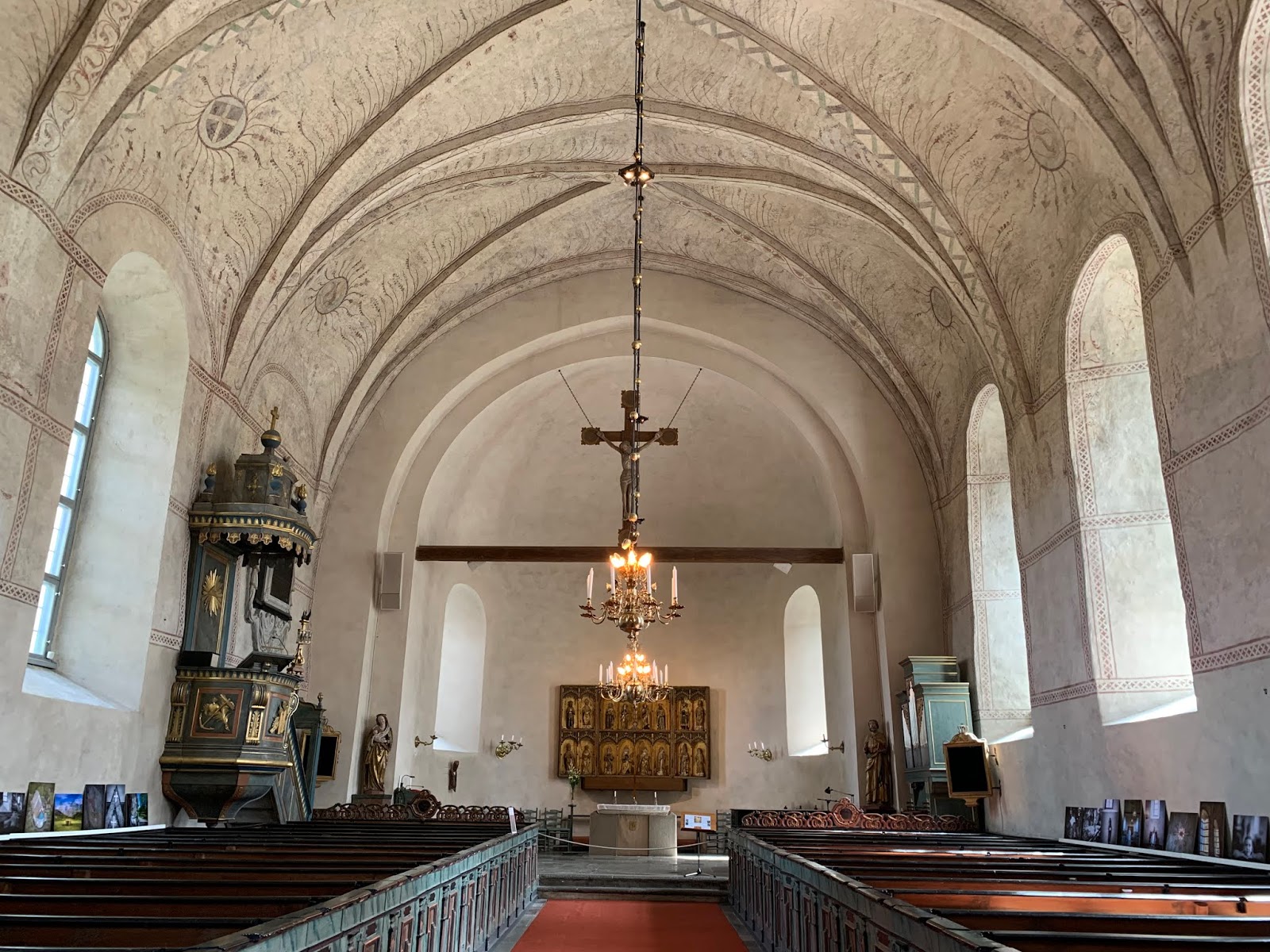
The Romanesque church was the original Uppsala cathedral, and inside it is wonderfully light and airy, with the remains of wall paintings and a number of medieval objects. It smelled amazing inside, and of course I loved it more than the new gothic cathedral in town. My favorite object was an 11th c chest made from the limb of a tree kept whole. Don't quote me on this, but Gamla Uppsala was originally a cult site with a very important sacred tree. Interesting that they left this limb as a chest, so you can still see its original form ... hmmm ...


After walking around the church and its timber bell tower (locked, darn it), we climbed the nearby burial mounds, which survive from the 5th and 6th centuries. They were very impressive, and the view from the top was satisfying. The surrounding countryside seemed quite flat from the manmade hills, and I could see all the way to Uppsala.


We then headed over to the picturesque Odinsborg Cafe for Fika! (teatime in Sweden). I had a blueberry tart and a much-appreciated coffee. A wonderful Sunday adventure!


Friday, June 21, 2019

Art Week 1!

When I went back this afternoon and looked at my 2013 blog posts, but I especially loved about them was how careful I was to document all the paintings I saw in museums! It's really sweet now to be able to go back and look at what I was most struck by on those early museum trips. In honor of my 2013 efforts, here is a (very) brief write-up about some art highlights i've seen in my first week here in Sweden.

Uppsala Cathedral 

Uppsala Cathedral is the seat of the (protestant) archbishop of Sweden, as well as being the national cathedral. It is equally as tall as it is long, and is made of local brick and limestone quarried in Gotland, a large island off the eastern coast that was particularly important in the medieval period. The cathedral was begun in the 13th c, replacing an older church in Old Uppsala, which was, in turn, replacing a pre-Christian sacred grove. While this Gothic structure was being built, the people of Uppsala used a nearby Romanesque church (which I hope to visit soon!). As soon as the chancel was complete, they moved in and began doing their services in the cathedral.

Since the 13th c, the cathedral has burned twice, which means very little of the original structure survives. The spire and towers are nineteenth century, as is most of the decoration. There are a few historiated capitals around the chancel, but I think there were originally more, and that they're probably not in their original positions. One of these capitals is horribly anti-semitic, though it wouldn't be immediately obvious to someone unfamiliar with medieval iconography. The cathedral has placed a plaque beside it alerting visitors to its difficult subject matter (not pictured).


The large apse of the church, originally a site of Marian devotion, was converted in the reformation to a shrine to King Gustav Vasa, the Swedish king who, upon his election, converted the country to Protestantism. He also decided that his sons would inherit his kingship, and elections ended. What a guy! There is now a contemporary piece outside this apse, a hyper realistic woman in a blue scarf, staring sadly into the apse. She looks so real that for a moment, I thought it was another visitor to the cathedral. Actually, it is a sculpture of Mary, peeking pensively into the venerated apse that she used to occupy.


One thing I particularly loved about the cathedral was the late nineteenth century wall paintings! Most cathedrals in Europe are no longer painted in their interiors, the medieval paint long gone and never replaced. However, many Scandinavian churches still have wonderful wall painting inside, much of it original Romanesque works. This church obviously lost its medieval paint, but wall painting was still important enough in Swedish church settings to require new images. These are done in a beautiful, Art Nouveau style, reminiscent of cigarette cases and posters scandalizing Paris in the same period. The angels are beautiful, but they do remind of liberated women in Golden Age Paris.

Job Cigarette poster, Alphonse Mucha, 1896
Angels in the spandrels of nave arches in Uppsala Cathedral, c. late 19th c 

The Augsburg Kunstkammer

In the early modern period, the very wealthy and educated loved collecting cabinets of curiosity in order to display how learned and important they are. Filled with a number of enchanting drawers and compartments, the wild assortment of objects inside was meant to contain the entire world in one cabinet. This is a very special kunstkammer, because it still has its entire original 17th c collection. It was given to the Swedish king by the city of Augsburg when he happened to be passing by with a large army and was interested in it. The cabinet includes paintings, corals, shells, gold coins, scientific instruments, a tiny sculpture excavated from the earliest Egyptian excavations, and a great many other perplexing and amazing items! A self-playing harpsichord type instrument was hidden in the top, beneath the enormous nut that crowns the entire piece. For a seventeenth century dinner guest, music coming magically from inside the cabinet would have been quite a party trick. 

My favorite detail is the beautiful marbles set in the doors. The marble itself may have been looted from Classical villas, maybe brought from Constantinople, Rome, or Athens. The colors are amazing, representing quarries from all over the mediterranean and who knows where else. Most interestingly, the marble has been painted with scenes! The natural colors of the marble make amazing backdrops for the little paintings. 


The Uppsala Anatomy Theater


Carl Linnaeus (1707-1778) was the most famous Enlightenment-era scientist to come out of Uppsala. A botanist, naturalist, biologist and archaeologist, he was a foundational researcher who achieved international renown for his work on cataloguing the world's plants, his advancements in medicine, and his invention of stratigraphical archaeology (analyzing layers of soil deposits to determine the age of buried objects). Linnaeus designed this anatomy theater, which is amazingly cramped and steep. The faux-marble columns on each level of the theater represent one of the orders of classical columns, and the windows in the ceiling let in an amazing amount of light so that students could see the dissection happening down on the table. 

When he got older, Linnaeus came up with a crackpot theory about Uppsala being the same place as Atlantis. When our guide told us this, I was cheeky and said "that's what happens once you get tenure!" and a full professor a few rows down was a little bit miffed. hee hee. 


Whew, that was a lot! I'm tired now. But I hope 2013-me would be proud. 

Beautiful Uppsala


Glad Midsommar!


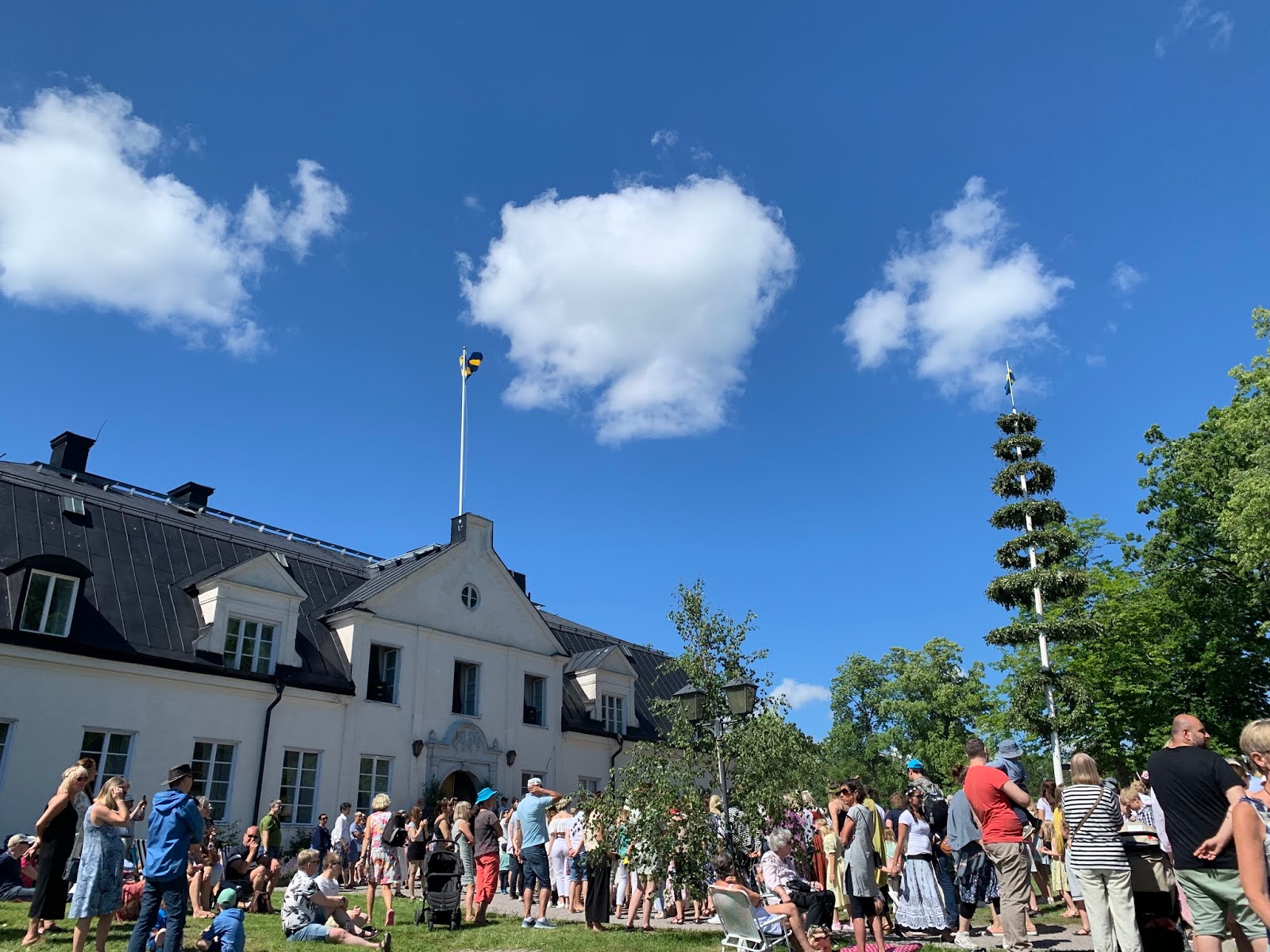
Today is Midsummer's Eve, a very important holiday in Sweden! In ye olden times, it was a most significant day for all Europeans (and others, of course--the summer solstice is worthy of remark all over the world!). In the Middle Ages, Midsummer was combined with the Feast of St. John the Baptist, the forerunner of Christ. John the Baptist's feast day marked the halfway point on the way back to Christmas! The celebration of his feast, and of the solstice, made for an interesting combination of Christian and earlier traditions, from bonfires and burning effigies, to dancing and music. Regional variation abounded. The priests often took part as well, facilitating the frivolity with the church's approval (better than letting the folk just do whatever they want, right?)


Here in Sweden, the tradition continues in full force! All the shops are shut, and they will be tomorrow as well. Uppsala is silent. So today, the UISS crew loaded onto a bus and traveled out to the charming town of Hammerskogs, about half an hour from Uppsala.


The weather was warm and breezy, and the countryside here is very green. We traveled through rolling hills flanked by distant forestland, catching sight of horses and cows, small houses and farms. Hammerskogs means something like Forest of the Hammer, which may refer to Thor somehow. We unloaded and walked up to the green, where the maypole had been erected (it is a fertility symbol, of course).


I ordered and ate a very nice hot dog (a korv I svenska), and walked with some of the other students in the program down to the lake's edge. An adventurous few had taken a swim. We gathered flowers and made flower crowns, as is tradition on Midsummer. Then, at Klockan tvo, the dancing began!


It was a wonderful day. What a joy to experience one of Sweden's most important traditions so soon after arriving!


Välkommen till Sverige


Goodness, it's been a really long time now since I've added anything to my blog! Poor bedraggled readers, who I imagine are in the thousands, staring hungrily at computer screens and getting absolutely nothing from me! Well, your ship has come in my friends, because I'm back! Looking over my posts from years ago reminds me again how much this forum has meant to me. The videos especially are so special now, six years on. I, now a most venerable Robyn, enjoy remembering those younger days.

I'm in Sweden for the summer! To explain very briefly, my dissertation research seems to be leaning towards work on medieval Scandinavia, and in order to pursue this interest, I need to acquire a Scandinavian language! This has led me here, to the picturesque town of Uppsala just north of Stockholm. Like Oxford, it was a medieval university city. The Swedes founded their university here in 1477, about two years before the Danes managed to get theirs up in Copenhagen.


Its a fairly rigorous course! I'm in class for seven hours each day, four hours in the morning (with a fika break--this is teatime for Swedes), and hour and fifteen minutes for lunch, and then two and a half more hours. That's more time spent in a classroom than I've had since my high school days, so I'm finding it a little overwhelming. I think in my PhD, I've become increasingly comfortable with brief periods of intense seminar time and then plenty of time alone to think about things, ha ha. Not so here!

I began my journey in Dallas. After a happy week spent with Alex, I flew from DFW to Heathrow, spent a twenty minute layover missing London, then on to Helsinki. I cleared customs in Helsinki, then continued on to Arlanda airport in Stockholm. I must admit, it was a pretty full-on itinerary. Two stops along the way is a bit much. But I made it safely and in good spirits to Uppsala by train, tramped down the King's road with my limited baggage, and checked in with UISS (The Uppsala International Summer Session).

My room is very nice! Internet comes to be via ethernet cable, and once I assembled a fan, I've been very comfortable. The single beds in Europe are so nice and long compared to twin beds in America. My feet never hang off the end! I have a lovely bath tub, and a big big window.


The city is very intimate, with many parks, flower pots, and trees. There's a little river that runs through the middle, separating the historic city from the newer half. Old Uppsala lies about 3 km away, and I will probably walk there in the next few days to see the old church and maybe some Viking things.


My first week was dominated by class, in which I am learning to foundations of a language I feel entirely unfamiliar with. We sing songs about little trolls, and are learning numbers, verbs in present tense, etc. In the afternoons, I'm in the Swedish art history class. Tuesday we went to see the wonderful cathedral here in town, and on Thursday we visited the university museum, home to a most amazing cabinet of curiosities. According to Johan, my art history instructor, this is the only cabinet to retain its entire original collection. We then walked up to the castle, which was horribly damaged in the 1702 fire. The surviving wing now functions as a contemporary art museum.

More to come!